Showing posts with label james perez. Show all posts

Thursday, July 14, 2011

James Perez Unveils the First Painting in his Upcoming Relics Series: The Necromancer.

The Necromancer
with blue light detail.
I've already discussed James Perez's Seven Deadly Sins series at length thus far, however I have also seen sneak peek of the very first painting (in a planned series of 12) of James Perez' next series, entitled "Relics". Most of the details of the new series are remaining under wraps for now, but what I can tell you is this - each piece will feature the use of REAL human skulls and bones. Yes, you heard me. Real ones.

Even the best of cameras (and mine is not the best) can't capture the true impact of a piece of art properly, but the following images will give you at least an idea of how awesome this is. I should also note that this particular piece has a multi-colored track lighting illuminating the painting at all times in a fairly dark room, so it morphs into red, green, blue, natural, pink lighting, and so on, adding an even more interesting spin on the piece. The piece, entitled The Necromancer, is on display in the back room of Cueto James Gallery if you'd like to see it in person.

Contact the gallery at www.cuetojames.gallery@yahoo.com for more info about or inquiries regarding purchase of this piece.

The Necromancer.
Mixed media on Canvas.


Close up of skull detail.

An Interview with James Perez about the Seven Deadly Sins series.

Artist James Perez (right) with wife Caroline Perez (left).
You mention in your bio that your work addresses the ways our needs for organized religion clash with our life experiences. Where do you fit on that spectrum currently? Do you consider your work to be religious art, or art about religion?
 
I think organized religion is an insidious element of culture that people do not spend enough time really examining for its consequences.  The human experience is a work of art, not a procedure. I don’t believe that subscribing to a belief system designed by someone else is aligned with the goal of understanding what we really are. I think any ideology that encourages people to value faith over reason is really dangerous. My art is about the way people, who are inherently flawed, gravitate toward excuses to be hateful, violent, and lustful and pretend those behaviors are justified by something righteous.
  
When did you come up with the idea of the Seven Deadly Sins series? How did you decide what to include?
 
I started working on the Seven Deadly Sins two years ago and completed the series in just over one year. I was thinking about painting on a subject that had a universal audience and a strong connection to the really ugly things in modern culture that people are largely complacent about. I wanted to make them look at those things so that just for a minute they couldn’t pretend the elephant wasn’t in the room.  I stopped painting for long stretches between each piece while I contemplated the subject that I felt most embodied the next sin.  Then, in a moment I would just see something in everyday life that was really awful and it would invariably fit.  It was important that each one represent an aspect of modern culture that any person could look at and understand, even if they don’t admit it.  

WRATH
In Wrath you depict the Prophet Muhammed in a less than flattering manner. How, if at all, was that piece impacted by the ways controversial depictions of Muhammed have been received in the past?
 
When I painted Wrath, I painted Mohammad Atta as I thought he would like to be painted. Why is it controversial to depict someone else’s truth?  People shouldn’t avoid the reality that glory is really a motive.   Mohammad Atta is like the Muslim Elvis. The thing I find that Muslims won’t say they agree with or disagree with is martyrdom.  I believe it’s because privately they endorse it.

Are you based in Houston? How did you first connect with the Cueto James Gallery?

I am in Houston. Rafael Cueto approached me about showing for the opening. The series was complete and represented the type of work the gallery is focused on supporting. Cueto James Gallery is committed to showcasing local artists that have strong work that may not be well received in galleries with more conventional ownership. Rafael believes in an artists’ right to creative control and is providing a setting where this type of work can be displayed.

Artist James Perez (right) with local DJ Jason Guillory (left).
I see there was an emergency change of venue at an earlier iteration of the show. What happened, and why was the venue changed?

Last year I had a show scheduled in the Houston Pavilions downtown. My work was not well received by the administration of the Pavilions and I was forced to find another venue less than 24-hours prior to the event I spent weeks publicizing. They would not even let me put up a sign to redirect people. I was worried we would lose people because we did not know how to get the word out, but the controversy generated a huge turnout.Roosevelt Lounge on Washington hosted the show for one-night and in the end we felt it was a much better venue.


GLUTTONY
Regarding Gluttony, you write, "This painting is not a criticism of Catholic or Hindu beliefs..." What would you respond to people who say it is critical of Catholicism and/or Hinduism?

I would say that I overtly used Catholic and Hindu imagery to convey that my subject is religion in general.  No single religion is the subject of that painting.  All major world religions are equally guilty of what I am implying about their invasive nature with impressionable minds.

When you say people, particularly children, are the "meal ticket" for religion, surely you don't mean that generally. Do you blame religion itself for the consuming, or particular religious leaders?

I believe that in general.  Religious belief is something that people go out of their way to instill in children.  If children did not have such impressionable minds, and if adults were not working so hard to force feed these ideas into those minds, I think religious ideology would naturally die out.  Religion lives on because people shove it down their kids throats, and those children grow up thinking those ideals are their own.  

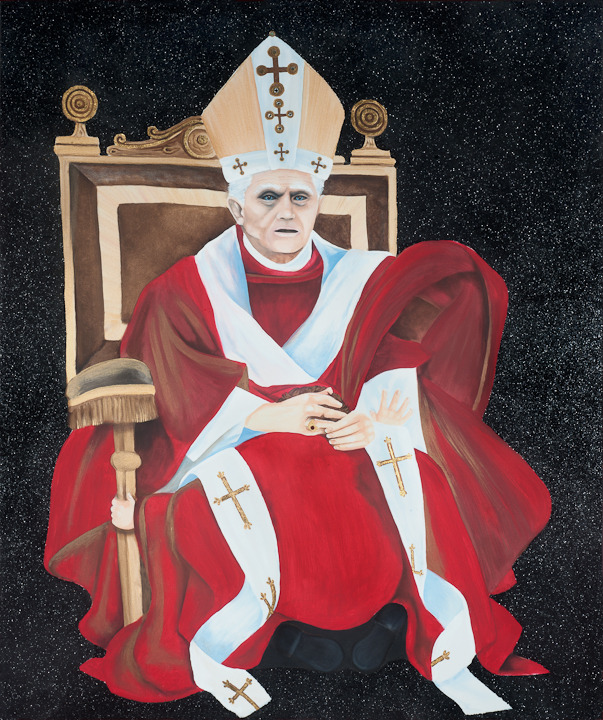
How do you expect Lust will be received in Catholic communities? You say it criticizes the pope's "direct involvement" but he is not "vilified." How does that work?

I don’t believe Lust will be received at all in Catholic communities. It’s well known that Benedict was a knowing enabler of pedophilia in the church – a fact which Catholics don’t vilify him for now  --  so why would this painting change that attitude? I expect most will dismiss the image rather than acknowledge the hypocrisy of having someone like that as a spiritual leader.

You say to look for familiar faces in Envy. Who is portrayed in the work?
 
Jon Benet Ramsey, Michael Jackson, John Wayne Gacy and the evil witch from Snow White.  

PRIDE

In Pride, are you responding to racist attacks on the president? If so, any particular ones?

I am not responding to racist attacks on Obama, but there are many messages about the dangers of Pride in this image. I find that a lot of people don’t understand the concept of pride. Somehow people tend to misunderstand that it’s a positive thing, but pride is what racism is all about. I chose pride of race for this sin because I feel that it’s the one people most universally justify to themselves.

In Sloth, you say it's a criticism of certain women. But aren't men to blame for the culture you are criticizing as well?

Yes men are to blame. But I expect women to rise above it.

A group admiring Perez's work.

Wednesday, July 13, 2011

Houston Artist James Perez: The Seven Deadly Sins Series & a Brief Artist Bio.

Houston artist James Perez recently sent shock waves through the community with his work, especially in the Heights area, where his last exhibition, the Seven Deadly Sins, was displayed at Cueto James Gallery. Seven large scale paintings - incorporating a wide variety of mixed media including oil paint, crushed glass, gold leaf, glitter, resin, etc - depicted the well known deadly sins in a way that demanded you to confront them head on. What you were forced to confront was not always easy to look at, but that's the point of Perez's work - he wants you to look right into the eye of this evil, and he's not afraid to use unorthodox measures and themes to ensure that you do.

It's unlike anything I've seen before, and no matter how you feel about the work, it will jolt you awake one way or another, and you will walk away thinking about what you've seen. Perez uses surrealism and fantasy to create images that are widely interpreted, often controversially, but they are always ultimately deeply personal to the viewer. By using elements of Pop Art combined with fantasy and surrealism, Perez conveys incredibly strong messages about iconography, making the Seven Deadly Sins series essentially unforgettable...even the local Channel 2 News came out to do a live report on the series!
 

Click HERE to watch a video clip of the Houston Channel 2 news segment regarding the "Pride" painting (features a brief interview with the artist himself).

**The series still currently hangs as the secondary exhibition at Cueto James Gallery, located in the Heights, at 1045 Studewood. For information regarding the gallery or the purchase of any of these works, contact the gallery: cuetojames.gallery@yahoo.com.**

See the series and the artist's explanations of the pieces below, taken from the artist's website:
GREED
This painting depicts famous televangelist Tammy Faye Baker consumed by illness in her later years of life.  This painting is a criticism of the abusive and predatory nature of television fund raising under the guise of Christianity.  This is a current example of the sin of Greed in modern society that condones common con-artistry.


LUST
This painting is not a comment against the Catholic Church, but instead is a statement criticizing the direct involvement of Pope Benedict in the modern Clergy abuse scandal plaguing the Catholic Church.  This is a current example of the sin of Lust in modern society that has destroyed the faith of millions, yet Benedict is not vilified for his personal involvement.

PRIDE
This painting is not a criticism of Barack Obama or the Government of the United States.  It depicts the sinful nature of Pride as it applies to the ugliness of racism.  We see the terrible consequence of extreme racial pride juxtaposed with the isolated prideful countenance of the victim portrayed.  This is a current example of the way pride of race isolates and divides modern American society.

SLOTH
This painting is a depiction of famous adult film star Jenna Jameson reclining in a bed of cocaine.  This is a criticism of women in modern society who use sexuality as a substitute for education and personal advancement, and thereby fail to contribute to the good of society.  This is a modern example of the way that Sloth dumbs down and degrades our culture through the lack of honest effort and hard work.

WRATH
This paining is a statement about the use of the Word of God as a weapon against humanity.  The well known leader of the 9-11 Terrorist bombings against the United States, Mohammad Atta, is portrayed as a prophet of wrath holding a Koran overflowing with his own misinterpretation of the Spirit of Islam.  This is a current example of the way the sin of Wrath misleads the faithful.

ENVY
This painting is a criticism of the child pageant industry and depicts the ugliness of envy surrounding the youth and beauty of young children.   The monsters and pedophiles attracted by this are a current example of the sin of Envy in modern society that condones the exploitation of children.  (Depiction of Jon Benet Ramsey.)
GLUTTONY
This painting is a representation of Religion, in generic terms, consuming humanity from childhood.  This painting is not a criticism of Catholic or Hindu beliefs, but instead portrays people as the “meal ticket” of organized religion, and depicts the way in which we are consumed by our belief systems from birth.

***

James Perez's biography (taken from his website) is rather enlightening after seeing his work. Read it below.

"My art is designed to move you.  Whether it moves you to the right or to the left, if it moved you I did my job."
- James Perez

As a child, Houston artist James Perez was exposed to an extremist religious cult known as The Children of God (C.O.G.) where he experienced radical expression of organized Christianity in its most bohemian form.  Documented in the book Heaven’s Harlots: My Fifteen Years in a Sex Cult, C.O.G. encouraged prostitution of its female members to raise money for the cult and as a means of finding lost souls with which to share the Word of God.  Like some modern Christian cults today, C.O.G. also believed in alien foundations for humanity.  Under intense scrutiny in the 1980s for its leadership under Moses David, the group was reformed and became known as The Family, which still exists today.  Child survivors of the cult have established forums for expression and communal outcry against the psychological and sexual abuses they sustained under the watchful eye of this Christian sect, often sadly ending in murder and suicide.  Exposure to this communal religious group from an early age predisposed James to a hardened view of the dangers and psychological damage that organized religion can inflict.  James’ art is for him, personally, a way of reminding himself that the messages we receive through organized religion are the design of man, and that they are set apart from belief or disbelief in God.

James' recent work focuses on contradictions in spiritual existence, how our relationship with organized religion fits with human sexuality, social drug abuse, the evil acts of man, and our place as a life form in the universe.  Handled separately, these subjects have benign and factual qualities that we compartmentalize.  When handled together on one canvas, these subjects become increasingly uncomfortable, creating a confusing mixture of emotion more closely imitating the way we feel in the experience of human life.  His paintings ask what we can accept about how our need for an organized explanation of existence clashes with the way we experience life, and ultimately whether we are able to accept the existence of each other.  He uses surrealism and fantasy to create images that are widely interpreted, but which always are ultimately deeply personal to the patrons they speak to.